

there's a phrase that has come to rise in the last while that goes like this: shiny new object syndrome. i don't know who coined it, but the saying started in tech circles, most notably the journalism side of things where writers rapidly move from covering one new thing to the next. they shower adoration upon a new gadget, or application and as quickly as they vociferously touted it, they would put it aside to bolster whatever was new, never really exploring in depth what any one thing in particular was capable of (features) or why people should use it (benefits).
shiny new object syndrome.
for the most part, SNOS has exhibited itself on the application front, specifically on the social media front. there's too many to count or keep track of that have fallen victim to this plague. the cycle goes that they launch, get a lot of media attention, there's some consumer uptake, and as quickly as they came to rise they seem to escape the popular consciousness. both media and consumers.
as of late, i'm seeing this model of adopting and disposing of things enter into the marketing world. of course it's due to the barrage of new media opportunities, web based or hardware based, that have entered the market in the last few years. and the malaise parallels that of the media coverage; we find them, we activate them, then we drop them.
all of us are to blame for this, myself included. we try to lead our consumers, or at least keep pace with them, so we jump to whatever they jump to. we as agencies make the recommendations and marketers themselves demand it. we keep aiming to be innovative and so we move on.
but there's one thing we forget - users don't stop what they started doing. they invest a lot of time and effort into their presence there. people haven't stopped using facebook, or myspace for that matter despite slowed growth and and plateaued usage. and think of how many people still have and use a hotmail account because that's the place they started. none of these are new anymore, but used just the same. in that regard, these are just as valuable places as all the shiny new ones. in fact, they may warrant more of our attention because they are proven (by still being alive) and our investment here would likely stand up. there's at least less risk our investment will be for not.
sure, there's the flash in the pan. we come charging out of the gate with that gets us noticed and some groundswell in our favor. but we have to also think of the longer life of the brand in these spaces. think about all the investment and all the equity you build into a property only to abandon it. consumers flock to us because of the value we provide. when we leave it fallow, we risk some consumer dissonance and in this powerful social age, it is too great a risk.
yes, there are temporary efforts that aren't sustainable. some efforts are in and out, but those need be efforts that are becoming of such an approach. but as it relates to the social media world and communities, there's no good reason why discontinuing efforts in this area is a good idea.
i'm not saying don't experiment. absolutely we should. it's about not abandoning what we start. seeing it through to it's real end. what that end is and when, i don't know. it just requires some thought about it rather than just dumping it. there's lots of great new things out there and there's room to give them a try, but where there is uptake and significance, keeping it up. we need to persevere to fully realize the potential of our presence in these spaces and get from our consumers what we desire.
shiny new object syndrome in marketing
p&g not sure about marketers in social media

in today's AdAge, the general manager-interactive marketing at p&g, scott mcconnell, pontificated that brands don't belong in social media, pointing to the difficulty these sites have had in monetizing their spaces. a couple of his points i took objection to and thought that mcconnell was off on his basis.
the easiest way for me to assess this is to go through the article top to bottom.
what in heaven's name made you think you could monetize the real estate in which somebody is breaking up with their girlfriend?...
... they were trying to talk to somebody. so it just seems a bit arrogant. ... we hijack their own conversations, their own thoughts and feelings, and try to monetize it.
the basic premise that this space is for consumers to have conversations (namely breaking up with their girlfriend - which is dubious to start with) and that brands don't have a place in that kind of environment is erroneous. consumers are having conversations about brands, branded content (ie. commercials), and how brands fit in their lives. granted, this probably doesn't happen as much as we'd like, but gentle pushes and good reasons to want to talk about our brands i don't see as problematic. yes, the main thing about facebook is for consumers to interact with each other (talking, sharing, etc), but it's certainly not exclusionary to brands.
to say that we hijack their conversations is completely unfounded. in no way do brands become associated with the personal dialogue of people on facebook. the only conversations our presence and our media become associated with are those of the community doing something with the brand itself and that is completely legitimate to want to capitalize on and promote. and the news-feed stories those propagate do not take over user conversations, just add new ones.
so the targeting is fantastic. you can do really amazing things. but i'm not so sure i want to be targeted like that. ... i don't think everything every consumer says to someone else and writes down is somehow monetizable by the media industry.
it is folly to say that he doesn't want to see highly targeted ads and thusly imply that other consumers don't want to as well. increasing ad relevance is a much better scenario for consumers and one that i think they'd actually appreciate. why do i want to see feminine hygiene products as it's completely irrelevant to me? i will ignore it and be left with a negative feeling about a brand or media channel.
however, if an ad appeared that met a certain specific needs, or was of high interest to me, consumers would pay attention, be more likely to respond and have a better feeling about the brand as it fulfilled something missing in my life. at the end of the day, there is consumer acceptance to seeing the ads there because they get that in order for the space to be a free service, it has to be ad supported. so if they have to see something, it might as well be appropriate.
as for our right as marketers to tap into consumer conversations and interests to target ads, i would bet that p&g puts money in search. that more or less taps into people's interests to target ads to them or in gmail tapping into keywords within to serve relevant ads. what's the difference there than in facebook or other social media spaces.
mcconell went on to say that marketers should not abandon the space entirely, and that there are potentially valuable vehicles for advertisers such as applications. this is a somewhat outdated viewpoint as facebook has severely curtailed their visibility. you have to have something really powerful to break through the wall Facebook has put them behind (literally and figuratively). it's a huge challenge that only very few brands could hope to accomplish.
they held promise when they were launched and facebook took the wrong approach and that ruined applications. facebook let anyone and everyone make their own applications and didn't vet any of them or put a pay model in place to launch them. this completely ruined the space as it was flooded with useless and invasive applications and they had to correct it. that correction was the redesign and it devalued them significantly. so to believe that applications are the promised land is a hard pill to swallow.
all in all, i find the article and his viewpoints showed a lack of understanding about the value of the social media space and how brands in fact DO belong there. it's a fine line and marketers have to approach cautiously. but it's rich and valuable territory if they can get it right.
twittersquatting
remember in the early days of the web (crica 1995) opportunistic schemers would buy up url's in the hopes to cash in on other people's trademarks only to have a short boon before it got litigious and not worthwhile? looks like there are still some who think this model is viable to this day, just in different shapes.
when i was recently setting up my slingbox, i ran into some tech issues. having looked at their website and not finding a solution, i sought other channels, one being twitter. i followed a thought that since dell and comcast had a few customer service reps on twitter, maybe more companies were following suit.
so i searched twitter for 'slingbox' and came across this:
now people are squatting on twitter names, much like they did domain names. did no one learn? one nuance though to the whole thing that will prove this to be not as easy a task to ameliorate: twitter is a free service. the trail is a lot easier to follow when someone pays like they did with domains. it could also be argued that twitter assumes people's 'handles' or 'nicknames' which may not be seen as a trademark for the companies like a domain would be.
there's also the matter of whether companies care. twitter is still very small, and only has a cult following right now. no one knows how mainstream it will get. do companies feel that twitter is a valuable signpost that they need to defend their brands in? if so, where does it end? How many variations of their namesakes can they snatch up so others don't? i believe companies should protect their trademarks, but only up to a point. twitter is never going to be the destination point that a url would be. i believe twitter could be a valuable asset to a company, but there's many who likely don't feel that way.
i wish there was a simple reporting feature to twitter as this afront to intellectual property and branding sickened me. i hope twitter can suss these hacks out, and all like them. i did a few other searches to see what other companies are going to have to trot out their lawyers and slap these hacks with some kind of cease and desist order or shutdown their accounts.
here's a few examples of companies who are likely being squatted on (a random sampling of brand names i find as i peer around my immediate surroundings):
probable squatting
canon, linksys, chrysler, microsoft, adobe, apple, mcdonalds, warnermusic, ebay, coca cola, nike, budweiser, ikea, google, xm radio, vonage
definite squatting
playstation, xbox, samsung
tech splurge
i've been on a bit of tech splurge lately. doled out some cash, spending a lot of time setting these devices up and trying to figure out how they will all fit into my life. here's a rundown of the recent acquisitions. this is by no means a review at any level of comprehensiveness, just how technology is enabling me.
netbook - acer aspire one
quick specs: intel atom running @ 1.6GHz, 512mb ram, 8 gig ssd hard drive, 8.9" screen, runs on linux lite, wi-fi enabled, 3 usb, 2 sd card readers, 3 hr battery life, webcam and loaded with all the open source productivity software you need.
i really fell in love with this device from the first time i saw it. super portable, yet fully functional. it's right in the middle of my smartphone and a laptop. i can't be that productive on the smartphone given the screen size and slower typing and navigation, but at the same time, the laptop was still a bit cumbersome and more intensive than a casual situation warranted. with the netbook, i feel at ease going to a cafe to drink and surf, or take on the subway for a little pre-work work.
where does it fit: right now it's opening up more situations that i want screen time, but before was always a pain to do with the laptop. now i can go to bed with my wife and catch up on my google reader without a bulky laptop on my chest or a huge screen shining in her face.
slingbox tv tuner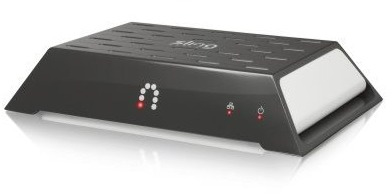
as if i needed to watch more tv. i first saw this device about 2 years ago when i previewed it at a digital conference. my initial thoughts were this is great for ex-pats who want a taste of the tv they're missing back home or heavy travellers to watch programming they're used to. neither situation terribly applicable to me so i kind of dismissed it. then i got one as a gift and took an about-face.
what i've come to love most about this is the ability to share it with all my friends. for nothing, i can point people to a piece of software to install and give them my profile info. from there, they too can enjoy live tv on their computer from anywhere.
where does it fit: mainly as background right now, especially for low involvement programming and the great company that tv provides. though i have a laptop, i still prefer to be desk based and the orientation of my laptop at the desk is not facing the tv. so this allows me to have the tv still in the background but without all the constant head craning.
linksys WRT610N wireless router with storagelink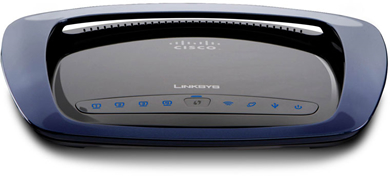
now having a wireless router is nothing new to me, but i had to get this one in particular to help me build an inexpensive network. the key to this router for me is the storagelink. it allows you to plug in a usb hard drive, creating a network drive that all your computers can access. so now all my music, movies, pictures, files, etc sits on this hard drive (and not slowing down my computer) and accessible anywhere. and by anywhere, i mean i can access it over the internet to so i have all my stuff, where ever i am, on any computer.
sure i could have bought a server for a few thousand, but this cost me $170 for the router and $100 for a 500gb usb drive and i still would have had to by the router with the server to get wi-fi. yes, it's also super fast operating at 5ghz for all kinds of multi-media activity without stuttering.
where it fits: mostly already said it above, i'm trying to go completely digital, and completely accessible. this delivers on that really well and really inexpensively.
smartphone - samsung blackjack II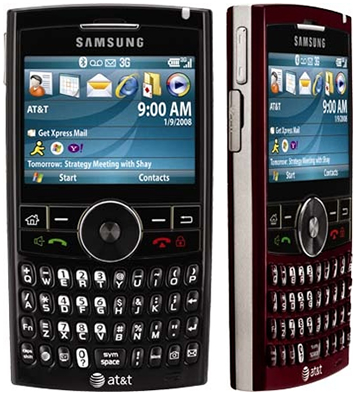
gone is the relic of a flip phone that used to have. in it's place a glorious and robust little smartphone i call jack. using windows mobile, this has a suite of programs to be all kinds of productive, manage my time and contacts, and even play some games. oh, the internet access on a reasonably sized screen isn't too bad either.
where it fits: obviously texting is a key component as i do a lot of that. so a full qwerty keypad makes that a lot easier. with a very small data plan i can access facebook and twitter anywhere to keep in touch. but the biggest reason for me is to have an easy way of jotting down notes, ideas, compiling lists, and genrally keeping track of data snippets.
so it's probably pretty apparent at this point that i'm a media junkie. the sum of all these parts is i'm taking in more information than ever. while all this technology allows me unequivocal access and unlimited data, it's the humanity of knowing when to stop, both in discovering new stuff and generally when to have other things in life.
olympic attitudes

in the sporadic viewing and news reading on the olympics (can i write that? do i have the rights to?), it's become pretty clear to me the differences in the national pride exhibited by the nemesis nations of america and china that have emerged. it's subtle, but important.
china is a country on the brink. they've been shrouded in mystery for centuries and
they are trying to shed the negative images of communism, being a backward nation, oppression, poverty, and human rights abuses.
the u.s.a. is a nation built on pride. how they became a country, their unique democracy, their fight for autonomy, their treatsies on what it means to be an american and even a human, their personalities, and so much more has instilled within the country, and all it's citizenry, a national pride that is currently unmatched.
specifically on the olympics, it's pretty clear to me both nations approach.
china is trying to show the world up. they seem to be doing it less for the purity and power of sport and the excellence of themselves, but rather to show everyone that they are a power. to show that they can do everything any other country can, and better. that it isn't the athletes competing, it's china competing. the athletes are secondary to china exerting a kind of dominance, proving that the country belongs on every world stage.
the americans aren't doing it to establish their nation, they've already arrived. but even before they arrived, it wasn't about that. it was about themselves. not showing the world their greatness, but reinforcing in themselves they are great. american athletes do it for their country, and the people to bolster their own sense of pride. natuarlly this comes off as egotistical, but it's unintentional outward boastfulness. they do it for themselves, and sometimes that comes across as conceited to the world.
respect plays a large part in it. china appears to be demanding the respect while the u.s. is, and has always gone the route of earning it. athletes in both countries work just as hard but the impetus and goals are different. to china, it is a tool for them to exhibit perfection as one example of the country's ability to be THE world power. to the u.s., it harkens back to their roots. they wanted respect and fought hard for it, proved they deserved it (ie. american revolution).
i've definitely gotten the sense that to china, losing is not an option. imperfection is not an option. no one likes to lose or fail, but we are human and as alexander pope said "to err is human." although the athletes are the focus, but it's also everything else surrounding the olympics which china has controlled and contrived as a way of telling the world they belong. for me, having the mentality of using the olympics as an outlet for a superiority complex is a little misguided. in a way it's saber rattling. i'd go so far as to say they are like a baby throwing a tantrum in a pay-attention-to-me way.
how long is a piece of string?
i'm reminded about a quote a college instructor of mine used with some regularity. she would say "how long is a piece of string?" when discussing research and information gathering. it's stuck with me through the years. lately it's come to mind with regularity as i've been reading a lot of blogs and other site feeds (around 50 or so regularly) these days.
what i've found with blog reading is just how long that piece of string can be. the goal of this post is encourage you to follow that piece of string. wherever it leads, and however far off the original topic you were reading.
blogs are inherently social (duh) and in having that quality creates a richer experience for readers. social not only in the sense of who reads, shares, and contributes (formally or commenting) but also in how it incorporates other locales and information sources on the internet, and points to them.
traditional media sources, web 1.0 sites included, don't have this quality. with them, it's generally read article and you're done. it goes against their models to include links, that would only take people away from their site. besides, they are the only news source for you, right? you don't need to go anywhere else. it's not in their interest to send you away and it robs you of a deeper understanding of the information you seek.
so what's following the piece of string? well, here's a typical saturday morning where i set out to do some reading online. i open up my google reader and pick one of the blogs, and an article i want to read. then i click on all the links in that article that i want to go deeper in and open them as new tabs in the browser. then on each of those pages, i open up links found there. wash, rinse, repeat for as long as i want to follow that piece of string.
in the end, you end up with not just a deeper understanding of your original interest, but likely quite a bit more on many related topics. not to sound corny, but it can be an interesting and rewarding journey. your eyes could be opened to something new.
keep the gas prices high
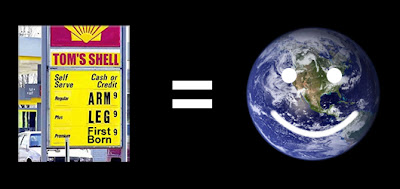
i'm going to go on record here and say that the rising gas prices are a good thing. of course not on our wallets, but as it pertains to the environment. what these high gas prices should be teaching us is to be more environmentally conscious not just in the interest of saving a buck.
here's a few positive areas where a high gas price is beneficial:
1) the immediate scaling back of gasoline usage
2) the increased pressure to find alternative power sources
3) greater composition of more fuel efficient cars on the road
of course, the one downside is the cost, but there's a positive spin there. it will only train people to be smarter about their consumption and will hopefully translate to better usage habits in the future for themselves and their children as they learn from their parents.
another outcome should be a correction in the supply/demand curve, or so economists would have us believe. meaning a temporary hard time where we push down demand but pay a high price should result in lowered prices as supply catches up. provided that we continue on with our ways that allowed this shift to happen, the prices of goods and services derived of and delivered by oil products will eventually fall. but can we as humans learn those lessons and keep on course?
in the spirit of full disclosure, i only use the car to play golf on weekends and pick up groceries here and there. so yes, it's easier for me to take this pov, but i can also look at it objectively. if i did drive more, i can guarantee that i would be much more conscientious about my driving. for one, i'm a cheap ass, so it would suit me to cut down.
i realize it's not a popular position to take, but everyone has to make sacrifices to turn this around. sure we'd like to put the onus on those with the financial means to do so, but change has to come from everywhere and everyone. to only force the wealthy to make sacrifices is a) not the largest cross section of the population therefore change will only go so far and b) we all are responsible so we all need to contribute to the solution. i understand it hits the poorest hardest, but if they get smarter too, then we all win.
i read an article recently in macleans talking about the woes of the airline industry, primarily as a result of rising gas prices. while i hate the notion of the impact the changes airlines are making and their impact if i wanted to travel, they are all necessary and smart means to achieve an environmental end.
similarly, we've already seen the impact on the auto industry, namely in the sales plummeting of larger vehicles. sadly it took up to this year for people to finally break and say $1.30/litre is too much and give up their gas chugging suv's and stop buying new ones. sure, i don't like people losing their jobs, but to turn the environmental ship around, it means we might have to go through some hard times. no one said it would be easy.
there is one flaw in all this, and that is the intent to save the environment is missing in most people. it's just a happy byproduct, if they even realize that. in respect of gas prices, people are out to save money first. that's the next step, getting people to realize that the behaviors that they will have to adopt to save money on gas are behaviors that they should use to save the environment.
about me
 travis st.denis
toronto, canada
 linkedin profile
 facebook profile
 youtube profile
 pic a day blog
cross-media planning guy with a bent toward digital and social media.
twitterings

currently reading
 Past Mortem by Ben Elton: Written in typical Ben Elton style, full of wit, shock, poignancy and suspense you'd expect from past books. With old friends like these, who needs enemies? It's a question that short, mild-mannered detective Edward Newson is forced to ask himself, having, in romantic desperation, logged on to the Friends Reunited website in search of the girlfriends of his youth. Newson is not the only member of the class of '86 who's been raking the ashes of the past. As his old class begins to reassemble in cyberspace, the years slip away and old feuds and passions burn hot once more. Meanwhile, back in the present, Newson's life is no less complicated. He is secretly in love with Natasha, his lovely but very attached sergeant, while comprehensively failing to solve a series of baffling and peculiarly gruesome murders. A school reunion is planned, and as history begins to repeat itself, the past crashes headlong into the present. Neither will ever be the same again.
subscribe/follow


panelist at
Toronto, Canada
April 7th & 8th 2009
Video Day
Toronto, Canada
April 21st, 2009


tracking
